Why Sahar Aziz’s Instagram Post About “Female Journalists” Raises Serious Questions
A Controversial Social Media Post From a Rutgers Professor
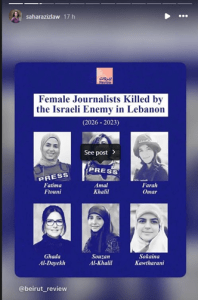
Sahar Aziz, a legal scholar affiliated with Rutgers University and a public commentator on Middle East politics through her Center for Security, Race and Rights, recently shared an Instagram post memorializing a group of women described as “female journalists” allegedly killed by Israel during the ongoing conflict in Lebanon and Gaza. The post framed these women primarily as members of the press and victims of war.
However, it has been quickly pointed out that several of the individuals featured in the post reportedly worked for media outlets directly associated with Hezbollah, the Iran-backed Lebanese organization designated as a terrorist group by the United States and many Western governments. These outlets include Hezbollah-linked television, radio, and propaganda networks that function not merely as independent journalism organizations, but as integral parts of Hezbollah’s political and ideological infrastructure.
For someone in Aziz’s position, and particularly as a professor associated with a major American university, publicly amplifying such material without clarification raises serious ethical and professional concerns.
Hezbollah Media Networks Are Not Neutral News Organizations
One of the central issues in this controversy is the characterization of Hezbollah-affiliated media workers simply as “journalists.” While some individuals employed by these organizations may have carried out reporting or broadcasting duties, Hezbollah’s media apparatus is fundamentally intertwined with the group’s political and militant operations.
Networks such as Al-Manar TV and Hezbollah-affiliated radio stations have long been identified as propaganda arms of Hezbollah. They are not comparable to independent Western news organizations that operate separately from political or militant entities. Instead, these media platforms openly support Hezbollah’s ideological mission, glorify its leadership, and promote the organization’s strategic objectives.
The United States has previously sanctioned or restricted Hezbollah media entities because of their role in supporting the organization’s broader activities.
That context is essential when discussing casualties connected to these networks.
By presenting these individuals solely as “female journalists,” Aziz’s Instagram post arguably omitted highly relevant information that would allow audiences to fully understand who these individuals were and the nature of the organizations they worked for.
Two Possibilities, Both Troubling
The backlash surrounding Aziz’s post stems largely from what many observers see as two possible explanations.
The first possibility is that Aziz did not know that several of the women highlighted in the post were affiliated with Hezbollah media organizations. If that is the case, it raises serious concerns about due diligence, accuracy, and judgment.
As a law professor and public intellectual, Aziz has a significant platform and influence. Public figures, especially academics speaking on politically explosive subjects, have a responsibility to verify information before amplifying it to thousands of followers. Sharing emotionally charged content without properly vetting the underlying facts contributes to misinformation and distorts public understanding.
The second possibility is even more controversial: that Aziz was aware of the affiliations and chose to omit them anyway.
And if someone knowingly presents Hezbollah media operatives merely as innocent “journalists,” it risks sanitizing or legitimizing organizations connected to extremist activity. Hezbollah is a U.S.-designated terrorist organization responsible for decades of violence, terrorism, and regional destabilization.
Under that interpretation, the post moves beyond advocacy for civilian casualties and enters the territory of political messaging that many Americans (including Jewish students and community members) would understandably find deeply concerning.
Why This Matters at Rutgers University
The controversy surrounding Aziz’s post cannot be separated from her role as a university-affiliated academic.
Universities are supposed to foster intellectual rigor, accuracy, and responsible discourse. Professors are free to express political opinions, including highly controversial ones. Academic freedom is an important principle in American higher education.
But academic freedom does not eliminate accountability.
When faculty members use their public platforms to share inflammatory or politically sensitive material, students and the broader public are justified in examining whether that content reflects responsible scholarship or ideological activism.
For many critics, the concern is not simply that Aziz expressed sympathy for women killed in conflict. The concern is that the post allegedly erased crucial context about Hezbollah-linked media operations while framing the issue in a way designed to generate emotional outrage against Israel.
That kind of selective presentation can contribute to polarization, misinformation, and distrust within academic institutions.
It also raises broader concerns about whether some academics approach Middle East issues through an activist lens rather than a scholarly one.
The Broader Debate Over Activism and Academia
This incident is part of a larger national debate about political activism among university faculty.
Over the past several years, many professors across the United States have become increasingly active on social media, where complex geopolitical conflicts are often reduced to emotionally charged slogans, images, and narratives. Critics argue that this environment rewards outrage rather than nuance.
The Israel–Hezbollah conflict is especially sensitive because it involves terrorism, civilian casualties, propaganda, regional warfare, and competing narratives about resistance and extremism.
In that context, accuracy and transparency matter enormously.
A professor with public influence should be expected to distinguish between independent journalists and employees of organizations tied to militant groups. Failing to make that distinction — intentionally or not — can seriously undermine credibility.
Conclusion
Sahar Aziz’s Instagram post has sparked controversy not merely because it criticized Israel, but because it allegedly portrayed Hezbollah-affiliated media figures as ordinary journalists without important contextual information.
If Aziz was unaware of the affiliations, critics argue it reflects a troubling lack of research and judgment from a prominent academic voice. If she was aware, critics contend the post raises even more serious questions about political bias and the normalization of extremist-linked organizations.
Either way, many observers believe the situation highlights a growing problem in academia: the blurring of the line between scholarship, activism, and political propaganda.
For a professor connected to a respected institution like Rutgers University, critics argue that higher standards of accuracy, transparency, and responsibility should apply, especially when discussing subjects as volatile and consequential as terrorism, war, and the Middle East conflict.
Related Posts
Sahar Aziz Supports Campaign to Reinstate Rutgers Graduation Speaker Rami Elghandour
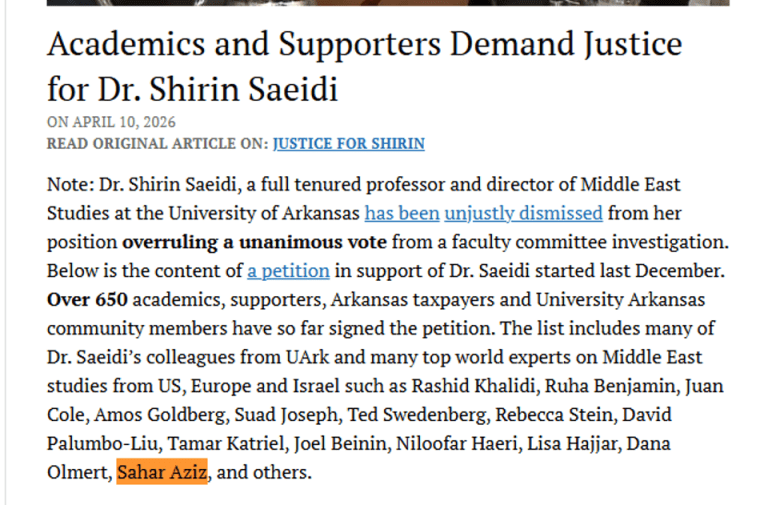
Sahar Aziz Among Academics Backing Fired Professor Shirin Saeidi After Pro-Iran Controversy